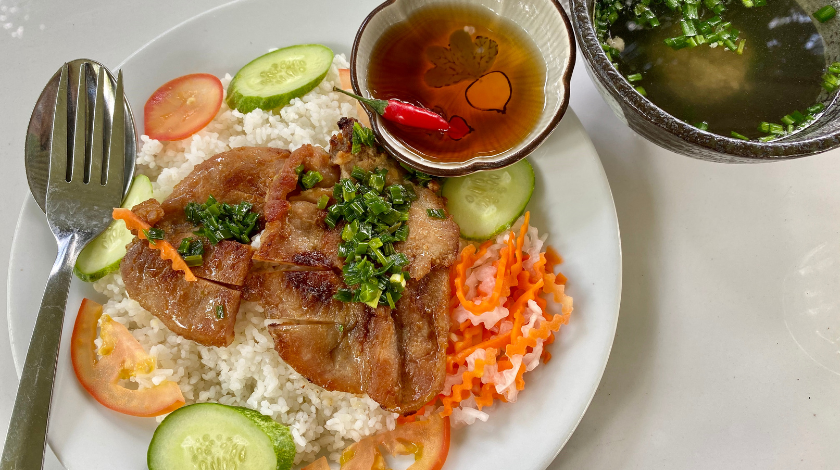
If you ever find yourself driving through the busy streets of San Jose or Milpitas in California, you might notice a specific scent lingering in the air. It is a sweet, smoky, and savory aroma that pulls you in before you even see the sign. That smell belongs to one place and one place only: Com Tam Thien Huong. For anyone who loves Vietnamese food, this name is more than just a restaurant. It is a landmark. It is a place where families gather on Sunday mornings, where workers grab a quick and filling lunch, and where the “broken rice” culture of Vietnam has found a true home in America.
What Exactly is Com Tam?
To understand why Com Tam Thien Huong is so special, we first have to talk about what “Com Tam” actually is. In English, we call it broken rice. Many years ago in Vietnam, this was actually considered a “poor man’s food.” When rice was processed, some grains would break into smaller pieces. These broken grains were harder to sell because they didn’t look as pretty as the long, whole grains. Farmers and poor families would keep these broken bits for themselves because they couldn’t afford to eat the high-quality rice. However, they soon realized that broken rice has a very unique texture. It is softer, more absorbent, and has a different mouthfeel than regular rice.
Over time, people started pairing this humble rice with grilled meats, egg meatloaf, and fish sauce. What started as a way to save money turned into a culinary masterpiece. Today, Com Tam is one of the most popular dishes in Saigon, and Com Tam Thien Huong has brought that exact street-food energy to the United States. When you eat here, you are not just eating a meal; you are eating a piece of history that has been refined over decades. It is a beautiful example of how something once considered “lesser” can become the star of the show.
The Story Behind Com Tam Thien Huong
I remember the first time I walked into the San Jose location. The place was packed. There was a low hum of conversation, the clinking of spoons against ceramic plates, and the busy movement of servers carrying huge trays of food. Com Tam Thien Huong has built a reputation based on consistency. In the restaurant business, being good one day is easy, but being good every single day for years is incredibly hard. This restaurant has managed to stay at the top of the list because they do not take shortcuts.
They have focused their entire identity on one specific dish. While many Vietnamese restaurants try to do everything—pho, bun bo hue, stir-fry, and spring rolls—Thien Huong focuses on doing broken rice better than anyone else. This specialization is what creates expertise. When you focus on one thing, you master the temperature of the grill, the fermentation of the fish sauce, and the perfect steam of the rice. This dedication to craft is what makes them an authority in the local food scene. People trust them because they know exactly what they are going to get every time they sit down.
The “Big Three”: Decoding the Suon, Bi, and Cha
If you look at the menu at Com Tam Thien Huong, you will see a lot of combinations. However, most people go for the “combination plate,” which usually includes the “Big Three”: Suon (pork chop), Bi (shredded pork skin), and Cha (egg meatloaf). Let’s talk about why these three work so well together.
First, let’s talk about the Suon Nuong, or the grilled pork chop. This is the heart of the plate. At Thien Huong, the pork is marinated in a mixture of lemongrass, garlic, sugar, and fish sauce. But the real magic happens on the charcoal grill. You can taste the “breath of the wok” or the char from the fire. The meat is usually thin enough to stay tender but thick enough to satisfy your hunger. It has those caramelized edges that are slightly crispy and sweet. I have tried to recreate this at home many times, but there is something about their industrial-strength grills that gives it a flavor you just can’t get in a kitchen oven.
Next is the Bi, which is shredded pork skin mixed with toasted rice powder. For beginners, this can look a bit strange. It is thin, translucent, and a bit chewy. But don’t let the texture scare you! The toasted rice powder gives it a nutty, earthy aroma that balances the sweetness of the pork chop. It adds a wonderful complexity to the dish. Finally, there is the Cha Trung, the steamed egg meatloaf. This is made with ground pork, wood-ear mushrooms, glass noodles, and eggs. It is soft, savory, and acts as a sponge for the fish sauce. When you get a forkful of the rice, a bit of the pork, a strand of the Bi, and a piece of the Cha, it is like a symphony of textures in your mouth.
Beyond the Basics: Why Tau Hu Ky is a Game Changer
While the “Big Three” are the classics, my personal recommendation—and what many regulars swear by—is the Tau Hu Ky. This is shrimp paste wrapped in bean curd skin and then deep-fried. If you haven’t had it, you are missing out on one of the greatest inventions in Vietnamese cuisine. The bean curd skin becomes incredibly flaky and crispy, almost like a pastry, while the shrimp paste inside remains juicy and savory.
At Com Tam Thien Huong, their Tau Hu Ky is legendary. It provides a loud, satisfying crunch that contrasts perfectly with the soft broken rice. I often tell my friends that if they are only going to add one extra thing to their plate, it has to be this. It’s oily in the best way possible, adding a richness that makes the whole meal feel like a luxury. It’s these little additions that elevate a simple plate of rice into a “must-have” experience that you will think about for days after you leave.
The Secret is in the Sauce: The Thien Huong Nuoc Mam
You cannot talk about Com Tam without talking about the fish sauce (Nuoc Mam). In fact, many Vietnamese foodies will tell you that the quality of a Com Tam restaurant is judged 50% by the rice and 50% by the sauce. If the sauce is bad, the whole meal is ruined. The sauce at Com Tam Thien Huong is a masterclass in balance. It isn’t just straight fish sauce from a bottle. It is a prepared sauce (Nuoc Mam Cham) that involves lime juice, sugar, water, garlic, and chili.
The version here is slightly thicker and sweeter than what you might find at a Pho restaurant. It’s meant to be poured generously over the rice and the meat. It acts as the glue that ties all the different elements together. The saltiness of the fish sauce brings out the savory notes of the pork, while the sugar complements the lemongrass marinade. I always ask for an extra little bowl of it. There is something so satisfying about watching the golden sauce soak into the tiny grains of broken rice. It turns the rice from a side dish into a flavorful star.
Location Spotlight: San Jose vs. Milpitas
Com Tam Thien Huong has a couple of main spots that people flock to. The one in San Jose on Story Road is perhaps the most iconic. It is located in the heart of the Vietnamese community. If you go there on a Saturday morning, be prepared to wait. But the wait is part of the experience. You see the community in action—grandparents talking about the old days, young kids eating with their iPads, and tourists trying to figure out what to order.
The Milpitas location is also excellent and often feels a bit more modern, but the food quality remains remarkably consistent across both. This consistency is a sign of a well-run business. Usually, when a restaurant expands, the quality starts to drop. However, Thien Huong has managed to keep the “soul” of their food alive in every kitchen they operate. Whether you are in the heart of San Jose or the outskirts of Milpitas, you know that the pork chop is going to be perfectly charred and the rice is going to be perfectly fluffy.
Pro-Tips for Your First Visit
If you are a beginner, walking into a busy Vietnamese restaurant can be a little intimidating. Here are a few tips from a regular to make your experience better. First, don’t be afraid of the “broken” rice. Some people think it’s just “bad rice,” but as I explained, it’s a delicacy. Second, order a side of canh khổ qua (bitter melon soup) if you want a truly authentic experience. The bitterness of the soup cleanses your palate between bites of the rich, fatty pork.
Third, look at the “Add-ons” section. You can add a fried egg (Op La) on top of your rice. Asking for a “sunny side up” egg is a pro move. When you break the yolk and let it run into the broken rice and mix with the fish sauce, it creates a creamy, savory sauce that is out of this world. Lastly, keep in mind that these restaurants are often “no-frills.” The service is fast and efficient, but they aren’t there to make small talk. They want to get the food to you hot and fresh. Don’t take it personally; it’s just the fast-paced nature of a high-volume broken rice shop!
Why It Matters to the Vietnamese Diaspora
Beyond the calories and the flavors, Com Tam Thien Huong represents something deeper for the Vietnamese-American community. For many immigrants who came to California after the war, food was the strongest link they had to their homeland. When they couldn’t go back to Saigon, they could go to Story Road and have a plate of rice that tasted exactly like the one they had at a street stall thirty years ago.
This restaurant provides a sense of belonging. It’s a place where the language is familiar, the smells are nostalgic, and the prices are fair. In a world that is constantly changing, Thien Huong feels like a constant. It’s a bridge between generations. You’ll see teenagers who barely speak Vietnamese sitting with their parents who barely speak English, but they are both smiling over the same plate of Suon Bi Cha. That is the power of good food—it communicates things that words cannot.
Conclusion
In the end, Com Tam Thien Huong isn’t just a place to eat; it’s a destination. It’s a masterclass in how to take a humble, historical dish and turn it into a culinary icon. From the perfectly marinated grilled pork chops to the crispy Tau Hu Ky and the balanced perfection of their fish sauce, every element of the meal is designed to satisfy. Whether you are a lifelong fan of Vietnamese food or someone looking to try something new, this is a place that deserves a spot on your food bucket list. It is authentic, it is delicious, and it is a true taste of Vietnam right in the heart of California.
Frequently Asked Questions (FAQ)
1. Is Com Tam Thien Huong beginner-friendly?
Absolutely! While the menu has many options, the staff is used to people from all backgrounds. If you are unsure, just order the “Special Combination” (often #1 on the menu). It gives you a little bit of everything so you can see what you like.
2. Is there a vegetarian option at Thien Huong?
Com Tam Thien Huong is very meat-centric, as traditional broken rice is built around pork. While they may have a few side dishes, it is primarily a destination for meat lovers. If you are a strict vegetarian, you might find the options limited.
3. Why is it called “broken rice”?
It refers to the actual grains of rice. During the milling process, some grains break. These smaller, “broken” pieces are what are used for this dish. They have a different texture that absorbs flavors and sauces better than whole-grain rice.
4. Does the restaurant take credit cards?
Most locations now accept credit cards, but it is always a good idea to have some cash on hand just in case, especially in older Vietnamese plazas where some smaller shops might still be cash-only or have a minimum purchase requirement.
5. What is the best time to visit?
If you want to avoid a long wait, try going on a weekday during “off-peak” hours, like 10:30 AM or 2:00 PM. Weekend lunch hours are notoriously busy, and you might have to wait 15-30 minutes for a table.